

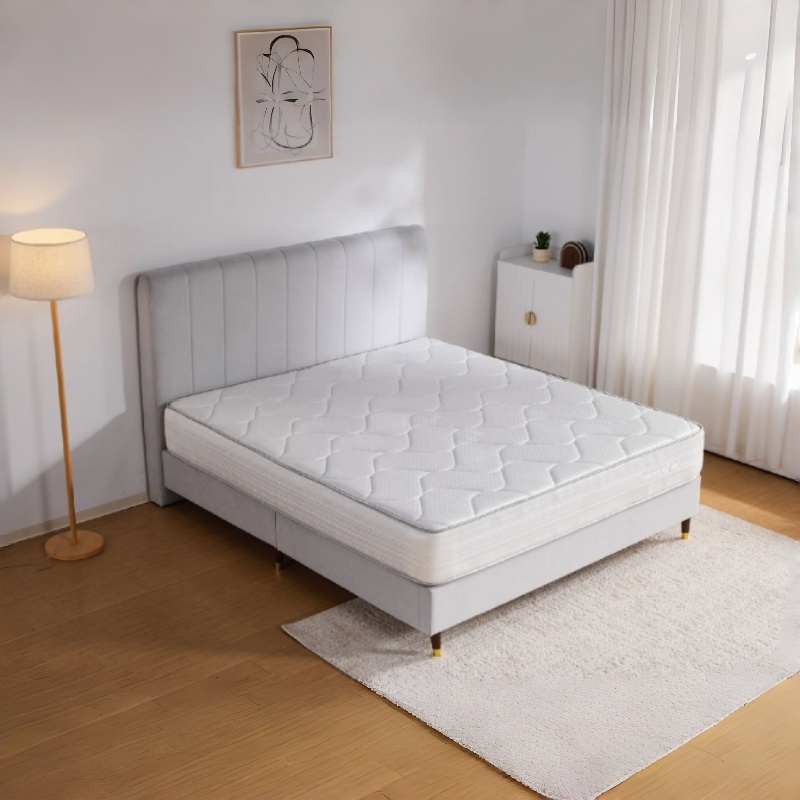
A mattress occupies more space in transit than many products of similar weight. Its broad shape limits how many units fit on a truck or in a warehouse bay, and carrying it through a building can require special handling. Compression changes that physical constraint for mattresses designed to recover afterward. Vacuum packing removes air from the structure, the mattress is rolled or folded as specified, and a compact carton replaces the full-size shape for part of its journey.
The logistics benefit does not arise from compression alone. It appears at successive handoffs: factory loading, container utilization, warehouse storage, inventory picking, and delivery to a home. Each stage uses the smaller package differently. The mattress still has to reach the sleeper in the intended size and condition after unpacking.
What Changes Inside the Carton?
A compressed mattress is temporarily reduced in volume under controlled packing conditions. Professional equipment applies vacuum pressure and wraps the product so it can be rolled into a carton. The process does not change its intended finished dimensions. Instead, it changes the form in which the product is transported and stored before use. Recovery after opening is therefore a product requirement, not an optional convenience.
Materials and construction determine whether that temporary state is suitable. Foam layers, spring systems, edge structures, and cover design respond differently to compression. A manufacturer has to test the selected design and define packing conditions rather than assume every mattress can be treated alike. The carton also needs identification that connects the packed unit to the finished model, size, and batch.
Suisin Furniture says it uses professional vacuum-packing equipment to compress and roll selected mattresses into compact cartons. The word selected matters: the company’s statement describes a packaging route for appropriate designs, not a universal property of all mattresses. A compressed mattress manufacturer can explain which constructions are approved for that route and how their recovery is checked before a large shipment is planned.
Why Transport and Storage Space Matters
Containers and warehouse positions are limited by usable volume as well as permitted weight. Packed dimensions and weight from a compressed mattress manufacturer let buyers compare container capacity with full-size shipment of the same model before estimating freight saving.
A smaller carton can allow more mattresses to occupy the same shipping space, provided the loading plan and weight limits still work. More units per trip can lower the average freight cost per mattress, although the actual saving depends on freight rates, carton dimensions, route, and the number of units ordered.
Compact cartons can also change warehouse operations. More units may fit on a shelf or pallet position, and uniform packages can simplify counting and movement through an inventory system. The benefit depends on how long stock is held and how the warehouse handles the cartons. A smaller package does not remove the need for clear labels, protected storage, or a process for matching each carton to a customer order.
For a mattress in a box manufacturer, the packed dimensions are part of the commercial specification. Buyers need carton size, weight, stacking limits, and handling instructions for the exact mattress model. A generic claim about space savings cannot replace a loading calculation based on the actual carton and shipment plan. The same product may have different economics on an ocean container, a local truck, and a parcel route.
How the Last Mile Changes
Traditional full-size mattresses can be awkward at apartment entrances, elevators, and narrow corridors. A carton may pass through those spaces more easily and suit home-delivery networks that are organized around boxed goods. E-commerce sellers can also store units closer to demand and ship an individual carton without arranging a specialist full-size mattress delivery for every order.
The customer still needs instructions for opening, positioning, and allowing the mattress to recover according to its design. Damage to the carton or a mismatch between label and product can erase the handling advantage. Retailers should also understand the return and service process, because a mattress cannot simply be repacked to its original compressed volume by a household user.
Suisin Furniture states that compressed designs can be customized in firmness, thickness, foam layers, spring systems, fabric, dimensions, and packaging, with OEM, ODM, and private-label support. Those options link product design to the intended sales route. A design meant for parcel delivery must be evaluated for its packed form and finished performance together; a visual brand change alone does not establish that the construction is compression-ready.
Measure the Benefit Across the Whole Route
The useful comparison is between complete delivery systems. Container loading, warehouse space, handling steps, last-mile access, and recovery performance all affect the result. A compact carton can improve several of those points, but a different mattress construction or a short local route may change the balance.
A mattress in a box manufacturer supports a credible logistics claim by confirming both the packed specification and the product’s verified finished state after recovery. The carton saves space only during part of the journey; the mattress earns that space saving by returning to the bed it was designed to fill.
