

Thermal nociception studies depend on controlled stimulation and behavioral endpoints. Researchers choosing a hot and cold plate should consider more than temperature range.
Heating and cooling capability, control precision, response timing, test modes, animal handling, data recording, and the distinction between single-plate and two-zone experiments all affect whether a system fits the intended analgesia workflow.
Match the Apparatus to the Pain Model
Start with the type of thermal sensitivity under investigation. Hot plate testing is commonly used to measure responses to noxious heat, while cold plate procedures can examine sensitivity to cold.
Thermal hyperalgesia and cold allodynia studies may require controlled temperatures in opposite directions, making a dual-function apparatus useful when both are part of the research program.
The conventional hot plate generally provides heating. A hot and cold plate adds cooling capability, allowing researchers to use one platform for both heat and cold stimulation.
Examine the Hot and Cold Plate’s Temperature Control
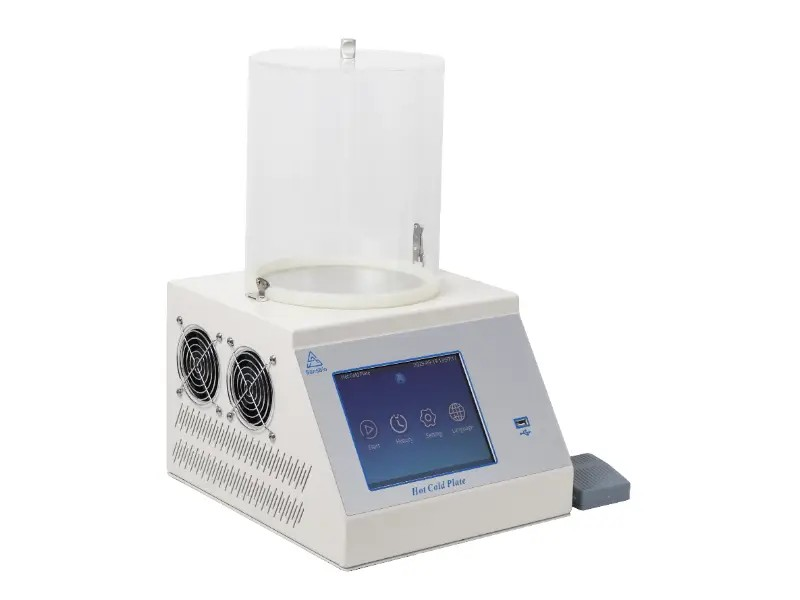
Compare the operating range, adjustment increment, control method, and temperature modes. The SA705 Hot/Cold Plate Analgesia Meter operates from -5°C to +65°C, with temperature adjustment in 0.01°C steps. It uses PID control, continuously collecting plate-temperature feedback to regulate heating or cooling.
Fixed and progressive temperature modes support constant-temperature protocols or programmed temperature changes.
Set Clear Response and Timing Rules
A hot plate assay commonly uses response latency: the time from thermal exposure until a predefined nocifensive behavior occurs. Reported responses can include paw withdrawal, paw licking, or jumping. The scoring rule should be established before data collection so operators know which behavior qualifies as the endpoint.
The SA705 records response latency at 0.01-second resolution through a foot pedal switch. Its time display covers 0.01–600.00 seconds, while experimental records include time, temperature, mean, maximum value, and minimum value. This connects the timing result with the thermal conditions used during the trial.
Consider Exposure Limits and Animal Welfare
Cutoff time is a key protocol variable in thermal pain experiments. A predetermined exposure limit provides a stopping point when the expected response does not occur. The value should come from the approved protocol and animal-care requirements rather than one universal schedule.
The literature emphasizes careful cutoff design because excessive thermal exposure can cause tissue damage. Temperature, exposure duration, strain, and study purpose can influence the appropriate protocol. Researchers should document cutoff and intervention criteria alongside the test settings.
Check the Animal Handling Setup
The physical enclosure should suit the animal model and allow observations without disrupting the trial. Researchers can review dimensions, access, visibility, cleaning procedures, and species compatibility.
The SA705 is specified for rats or mice. It uses a metal temperature plate and a cylindrical restrainer, with an apparatus size of 350 × 300 × 485 mm and a listed restrainer size of 210 × 250 mm. The unit weighs 12.5 kg and has a sound level below 60 dB(A).
Distinguish Single-Plate Testing From Thermal Preference Studies
The SA705 is designed around a single temperature-controlled plate for analgesia and thermal sensitivity testing. It does not perform automated preference measurements between two different temperature zones.
Laboratories investigating temperature choice can instead use the SA707 Thermal Place Preference System, which is designed for automated two-zone experiments.
Inspect Storage and Export Options
Data handling can influence laboratory workflow, particularly with repeated sessions or several treatment groups. Look for onboard storage, export formats, display options, and whether PC-based operation is necessary.
The SA705 operates independently through an 8-inch capacitive LCD display with 800 × 600 resolution. It stores up to 100 data records and exports results through a USB flash drive in CSV format. PC software is also available for laboratories that prefer remote control and analysis.
Choose a Platform That Fits the Study
Selecting a hot and cold plate involves matching the apparatus to the thermal stimulus, behavioral endpoint, exposure rules, and data workflow. A laboratory studying both heat and cold sensitivity may value dual thermal control, while a study centered on one paradigm may need another configuration.
BioMed Easy Technologies develops laboratory animal and neuroscience research equipment as a subsidiary of SANS Biotechnology. Its history records 2,200 m² of R&D and manufacturing space in 2017, after the company was founded in 2016.
Its manufacturing began in 2017, and its manufacturing center expanded to more than 7,000 m² in 2024. CE and ISO9001 certifications are listed on its official site.
Its portfolio spans categories such as motor coordination, pain and inflammation, learning and memory, anxiety, fear and emotion, reward and addiction, and metabolism.
The SA705 brings heating and cooling, fine temperature adjustment, foot-pedal latency recording, independent operation, and USB data export to a single-plate thermal-testing workflow.
Review the official SA705 specifications to compare temperature range, control modes, timing, data functions, and physical setup with your protocol. BioMed Easy can help match the SA705 to the temperature, timing, and data requirements of a specific analgesia research program.
