

Order quantity alone rarely settles the manufacturing route for a plastic part: printing, machining, and molding carry different upfront commitments. Geometry, resin properties, expected reorders, and the maturity of the design all change the calculation.
For this reason, custom injection molding services become a practical option when the expected benefits of molded parts justify a dedicated tool and the work needed to qualify it. The meaningful comparison is between complete production routes, not isolated machine cycle times.
Separate the Quantity Forecast From Design Stability
An initial quantity describes today’s demand; tooling decisions depend partly on what happens after that delivery. A part ordered in modest batches over several years presents a different case from an experimental enclosure likely to change next month.
The forecast can distinguish an evaluation lot, the first commercial order, and possible repeat batches without assuming that any forecast is guaranteed. Tool investment is easier to judge when those scenarios are visible alongside the anticipated revision schedule.
Design stability also has a technical meaning. Mounting locations, mating clearances, material grade, visible surfaces, and insert requirements must be sufficiently defined for tooling to be planned.
A prototype may confirm the overall shape while leaving snap features or critical clearances unresolved. In that situation, additional printed or machined trials may be less disruptive than cutting a mold and then altering it. Early order size cannot compensate for unresolved functional requirements.
Product families complicate the quantity forecast. Several color versions made in one geometry may share tooling, subject to material and processing compatibility; designs with different fastening layouts may instead need tool changes or separate cavities. A forecast should distinguish total demand from demand for each unchanged configuration. An apparently substantial program can consist of many small, unstable variants, weakening the economic case for a dedicated mold.
Compare Alternatives at the Same Delivered Condition
Additive manufacturing avoids dedicated mold construction for a small functional trial, while CNC machining can produce certain plastic components directly from stock. Injection molding introduces tooling preparation but offers a repeatable cavity-based method once the part and process have been qualified.
A comparison of custom injection molding services with those alternatives should include the same resin or relevant material requirements, the finish needed at delivery, dimensional acceptance, and any assembly steps. A low quoted piece price means little if the tooling, inspection, or finishing scope is excluded.
Geometry often decides which of those routes is workable. A machined polymer part may be suitable for a straightforward bracket, yet a thin-wall enclosure with integral clips and a specified texture may be better suited to a molded design once quantities support the tool.
A printed part may demonstrate the clearance of a cover but not reproduce every property of the proposed production resin. These distinctions matter before any single-volume break-even calculation, which cannot be assumed without project-specific cost information.
Account for Tooling and Resin Behavior
Molding cost begins with a cavity that can fill, cool, and release the part. Gate position, draft, cooling layout, cavity count, and expected shrinkage affect both tooling complexity and the dimensions of finished pieces.
For this tooling commitment, DFM and mold-flow review at Hanstar Technologies precede in-house moldmaking; injection molding and secondary processing form the subsequent production stages. The tooling operation manufactures more than 300 molds annually, with tooling precision down to 0.005 mm; that number applies to moldmaking, not to every plastic part emerging from the mold.
Material behavior changes the comparison as well. Available molding grades include ABS, PP, PE, PC, PC/ABS, PA6/PA66, POM, PBT, PPS, PEEK, and reinforced engineering polymers, along with TPE and TPU elastomers.
Different polymers exhibit different shrinkage, stiffness, and processing requirements, so final part tolerances cannot be inferred from machine capability alone. The company’s typical molded-component tolerance is approximately ±0.02 mm, subject to the resin, geometry, and critical feature being specified.
Plan Trials, Finishing, and the Next Order Together
Even a modest production run needs time for process setup, trial inspection, and any tool adjustments revealed during commissioning. Dimensional inspection, appearance, assembly fit, and any insert or overmolded interface must be reviewed under agreed acceptance conditions.
Metal threads or bushings may be molded into suitable components, and rigid plastic can be combined with a soft TPE/TPU layer where the design calls for overmolding. Secondary trimming, engraving, painting, ultrasonic welding, and assembly may also belong in the delivered-part specification.
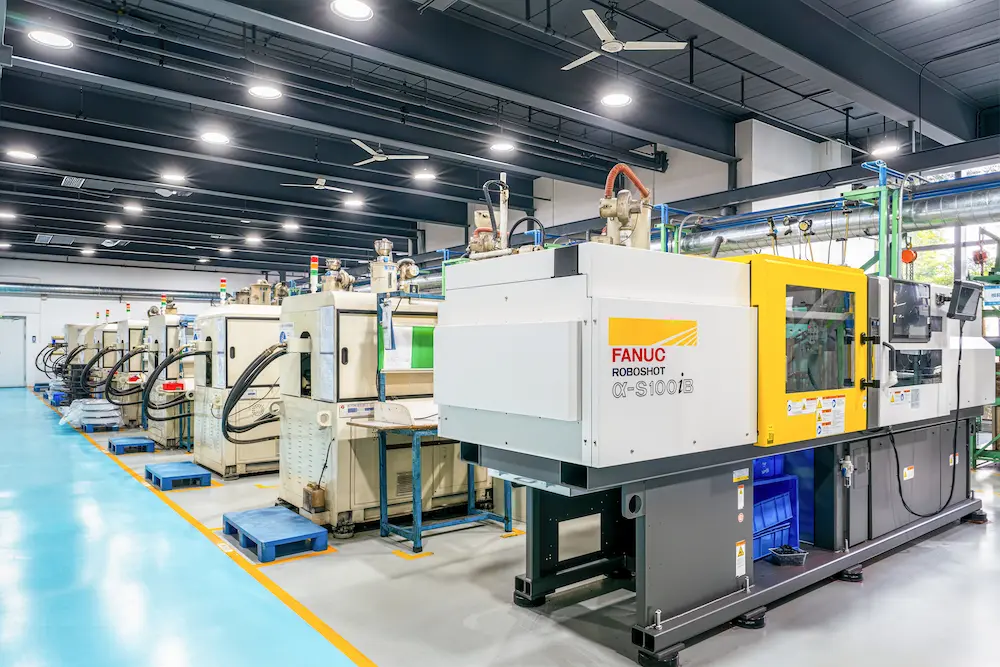
Hanstar Technologies operates eighteen injection-molding machines, including an all-electric FANUC ROBOSHOT α-S450iA, and supports prototype, low-volume, and recurring production programs. It does not impose a fixed minimum quantity on prototyping and low-volume molding inquiries; exact terms depend on the project.
For custom injection molding services, a useful acceptance sequence distinguishes tool trial, first-piece measurement, in-process control, and the records carried into subsequent batches. Tooling readiness and reorder frequency are therefore commercial inputs as well as production-planning details.
An approved design with plausible repeat orders may justify tooling; an unstable part at the same initial volume may not. Before committing to a mold, project teams can bring Hanstar Technologies a controlled model, resin specification, required finish, initial quantity, and likely reorder volumes for a project-specific route assessment.
