

Packaging and industrial design play an important role in shaping how oral care products are understood, experienced, and positioned in the market. For brands developing private label oral care products, decisions about product appearance, usability, materials, and packaging can influence both customer perception and manufacturing feasibility. A well-planned design approach therefore needs to connect branding, functionality, user experience, and production from the beginning.
Why Packaging Matters Beyond Protection
For buyers developing private label oral care products, packaging is more than a container. It protects the product through transport and storage, but it also communicates positioning before a customer uses the device. Research on product design shows that visual form can influence perceived value and consumer responses, making packaging a commercial tool as well as a protective layer.
In oral care, packaging often has to explain unfamiliar functions quickly. Water flossers and nasal care devices can differ in modes, controls, accessories, and operating methods. A clear hierarchy of product images, key features, technical information, and usage cues can help shoppers understand the offer without making the package visually crowded.
Packaging should also work across sales channels. A carton displayed on a retail shelf has different visual conditions from a product shown on an e-commerce page or in a distributor catalog. Consistent typography, imagery, dimensions, and brand assets help buyers maintain a recognizable product identity while adapting packaging layouts to different commercial environments.
Industrial Design Connects Appearance and Usability
Industrial design goes deeper than color or surface finish. It covers how a device looks, feels, fits the hand, uses space, and communicates its intended function. Research in product design identifies aesthetic, functional, and symbolic dimensions as important influences on consumer responses.
For an oral care manufacturer, this means design decisions should be evaluated alongside engineering requirements. Button placement, grip geometry, tank access, nozzle storage, visual indicators, and charging interfaces can affect how easily users understand and operate a product. A refined exterior is valuable only when the physical architecture supports reliable use and practical maintenance.
The strongest packaging and product concepts are developed together. Product dimensions influence carton size, protective structures, accessory placement, and printed instructions. At the same time, packaging can reinforce the design language of the device through shared colors, graphics, finishes, and visual proportions. This alignment creates a more coherent presentation from first impression through unboxing.
Design Choices for Private Label Oral Care Products
Private-label programs usually require more than applying a logo to an existing model. Buyers may need different colors, finishes, packaging structures, artwork, accessories, or user-interface details to fit a specific market position. Design teams therefore need a clear process for translating brand requirements into manufacturable specifications rather than treating creative concepts as separate from production.
A practical process starts with the target market, retail environment, intended price position, and expected user profile. From there, teams can define the product form, CMF direction, packaging architecture, graphic hierarchy, and required technical information. Prototypes and design reviews then help identify problems with appearance, ergonomics, assembly, or packaging fit before larger production commitments are made.
This is where a capable oral care manufacturer can reduce development friction. A partner that connects industrial design, structural engineering, packaging, quality, and manufacturing can evaluate whether a concept is feasible before tooling and mass production. That integration is especially relevant when private-label projects have tight launch schedules or require repeated design iterations.
How Flycat Connects Design With R&D
For brands sourcing private label oral care products, Flycat presents design as part of a broader development system. On their R&D and quality page, they state that structural engineers review ID drawings and CMF specifications before prototype development, followed by structural, electronic, and packaging design. Their process then moves through engineering and pilot-build stages, compliance confirmation, and preparation for mass production.
This approach matters because packaging decisions can create downstream engineering or quality issues if they are made too late. Flycat says their R&D, Quality, and Engineering teams jointly audit and evaluate prototypes, while their quality process continues through pilot production and finished-product inspection. For buyers, this provides a structured path from concept review to production validation.
Their wider oral care portfolio includes water flossers and nasal irrigators, with handheld, portable, and countertop categories. Their website also positions Flycat as an OEM/ODM partner for global brands, supporting product development through mass production. These capabilities are relevant when buyers are comparing an oral care manufacturer for a new product program.
What Buyers Should Evaluate Before Launch
When assessing a supplier for private label oral care products, buyers should ask how packaging and industrial design are handled across the full development cycle. Key questions include whether the supplier can review CMF requirements, validate product structure, develop packaging, test prototypes, and connect design decisions with compliance and production requirements.
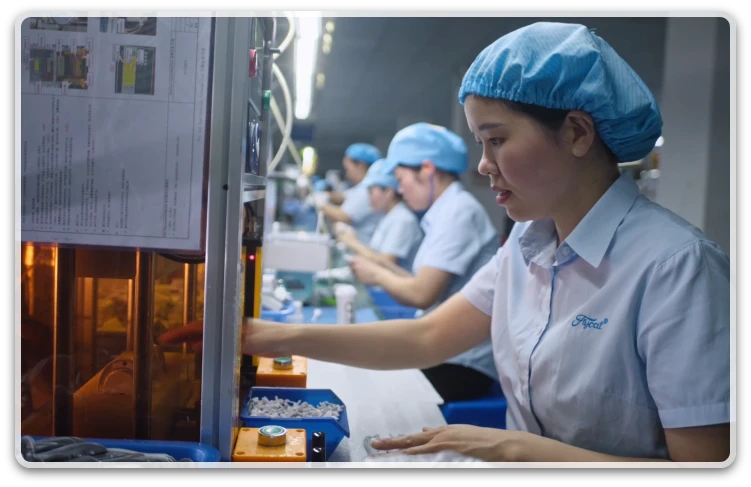
It is also important to evaluate manufacturing readiness. Flycat states that they operate 30 production lines, with daily capacity of up to 30,000 units, and use standardized R&D and testing procedures. Their R&D and quality page lists ISO 9001 and ISO 13485 certifications, together with regulatory and market credentials including CE, FDA, FCC, RoHS, and PSE.
Ultimately, successful private label oral care products need consistency between what customers see and what they use. A well-designed box cannot compensate for an awkward device, while a strong product can lose impact through confusing packaging. Flycat combines industrial design review, packaging development, prototyping, testing, and production support, giving brands a more integrated framework for developing differentiated oral care products.
