

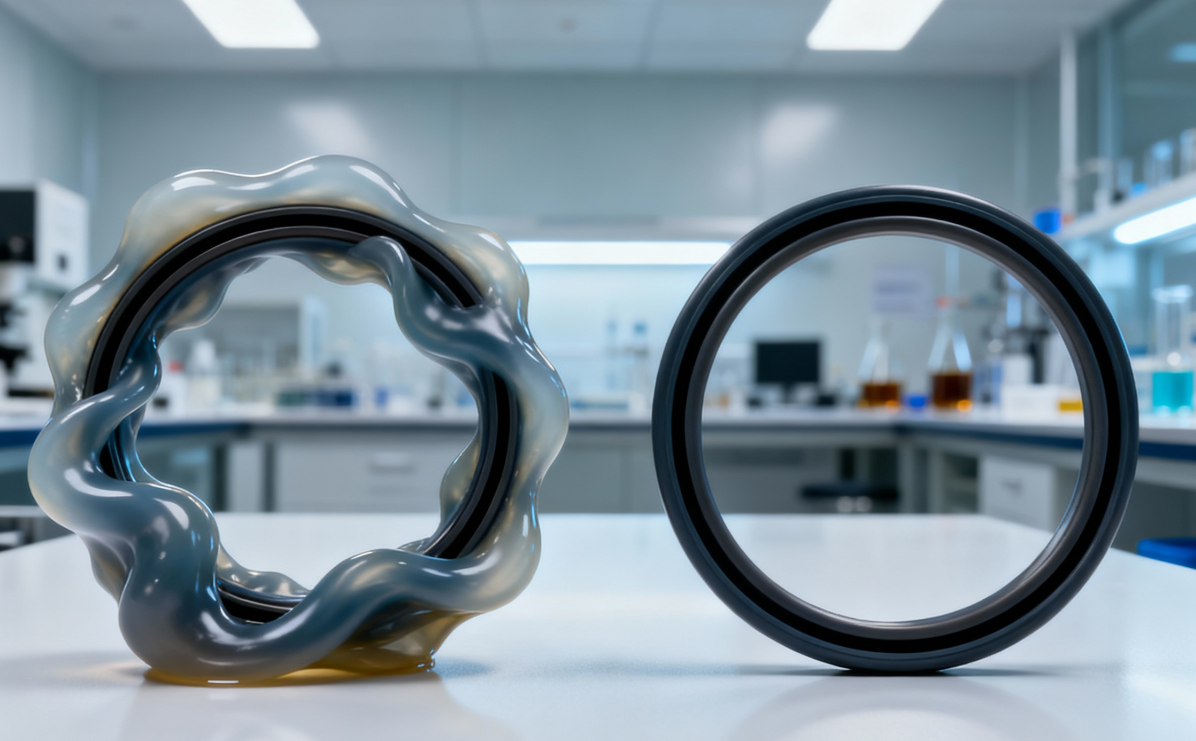
Standard Liquid Silicone Rubber (LSR) provides exceptional thermal stability, yet it fails catastrophically when exposed to automotive hydrocarbons. For engineers designing fuel systems, this material incompatibility leads to dangerous leaks due to rapid volume swelling. Fluorosilicone (FVMQ) LSR solves this challenge by integrating the chemical resistance of fluorocarbons with silicone’s flexibility. Implementing this material requires a specialized liquid silicone rubber injection molding process designed to handle high-value fluorinated compounds with micron-level precision.
The Science of Material Failure: Why Standard LSR Cannot Withstand Fuels
Automotive sealing environments are unforgiving, requiring elastomers that maintain physical integrity despite constant exposure to aggressive fluids. Understanding the chemical divergence between standard VMQ and FVMQ is critical for preventing system failures.
Chemical Resistance Mechanics and Volume Swell Analysis
The failure of standard methyl-vinyl silicone (VMQ) in fuel systems is governed by the “like dissolves like” principle. Non-polar automotive fuels easily penetrate the non-polar siloxane backbone of standard LSR, causing polymer chains to separate. This results in severe volume swell, often exceeding 150% when immersed in Reference Fuel C (a toluene-isooctane blend simulating gasoline) for 72 hours at 23°C.
In contrast, FVMQ incorporates trifluoropropyl groups along the polymer backbone. These highly polar fluorine atoms create a steric hindrance effect that actively repels non-polar hydrocarbons. In the same Fuel C immersion test, FVMQ typically exhibits a volume swell of less than 20%, maintaining its tensile strength and hardness. This stability is non-negotiable for meeting EURO 7 and EPA emissions standards, which strictly limit fuel vapor permeation.
Meeting Thermal and Dynamic Requirements
While Fluoroelastomers (FKM) also resist fuel, they often fail at low temperatures. FVMQ offers a unique operational window, retaining elasticity down to -60°C—essential for cold-start sealing in winter climates—while withstanding continuous operation at +220°C in turbocharger proximities. This dual-capability makes FVMQ the superior choice for dynamic applications like fuel injector O-rings and pulsation dampener diaphragms, where standard LSR would degrade and FKM would become brittle.
Optimizing the Injection Molding Process for Fluorosilicone Components
Processing FVMQ requires a highly refined custom liquid silicone rubber injection molding strategy. The material’s high cost and unique rheology demand strict process controls to ensure economic viability and part quality.
Specialized Machine Configuration and Corrosion Control
Molding FVMQ presents distinct challenges compared to standard silicone. The presence of abrasive fillers and potentially corrosive byproducts during vulcanization necessitates the use of a specialized liquid silicone rubber injection molding machine. The plasticizing unit must feature corrosion-resistant bimetallic screws and barrels to prevent metallic contamination.
Furthermore, precise temperature control is paramount. FVMQ compounds often have a narrower scorching safety margin. The barrel temperature must be strictly maintained below 25°C to prevent premature cross-linking, while the mold temperature requires precise multi-zone heating to ensure uniform curing without degrading the polymer’s fuel-resistant properties.
Managing Shrinkage in OEM Rubber Injection Molding
FVMQ typically exhibits higher and more non-linear shrinkage rates (2.5% to 4.0%) compared to standard LSR. In an oem rubber injection molding context, this requires sophisticated tooling design. Engineers must apply non-uniform scaling factors during the mold design phase to compensate for anisotropic shrinkage. Additionally, because FVMQ is a high-value material, flash control is critical. Advanced cold deck systems with needle valve gates are employed to minimize material waste, ensuring that the cost per part remains competitive while delivering flash-free, high-precision seals ready for automated assembly.
Livepoint Tooling: Precision Engineering for Automotive LSR Solutions
Livepoint Tooling delivers certified, high-precision manufacturing solutions for the automotive sector. They specialize in processing complex materials like FVMQ for critical fuel and energy applications.
Certified Quality Assurance and Automotive Expertise
As a premier liquid silicone rubber injection molding manufacturer, Livepoint operates under strict IATF 16949 and ISO 9001 certifications. This ensures that every fuel system component meets the rigorous traceability and quality standards demanded by global automotive OEMs. Their facility is equipped with advanced CMM inspection technologies, allowing for the non-destructive verification of internal seal geometries and defect-free production runs essential for safety-critical parts.
Comprehensive Manufacturing Capabilities
Livepoint supports the entire product lifecycle, from rapid prototyping to high-volume mass production. Their expertise extends beyond standard molding to advanced 2-Shot (2K) molding, enabling the chemical bonding of FVMQ seals directly onto rigid engineering plastics like PA66 or PBT. This capability reduces assembly steps and eliminates potential leak paths. By integrating in-house mold making with intelligent production systems, Livepoint ensures consistent quality and dimensional stability for millions of cycles.
Conclusion
For automotive engineers, FVMQ LSR is the indispensable material for fuel contact applications, bridging the gap between low-temperature flexibility and hydrocarbon resistance. Partnering with a specialized liquid silicone rubber injection molding company like Livepoint Tooling ensures these complex materials are processed with the precision required to guarantee long-term system reliability.
