

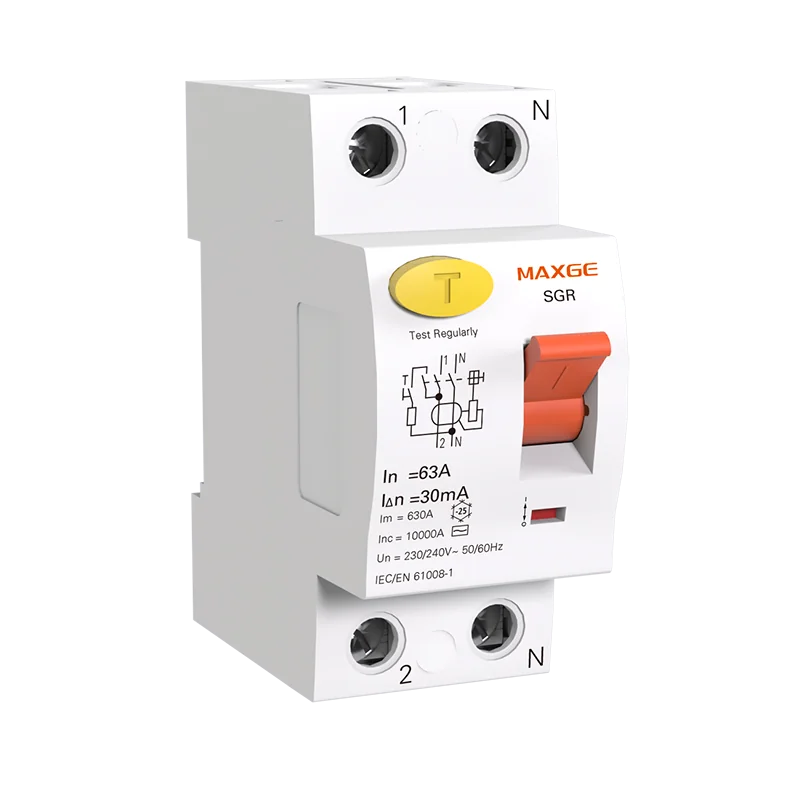
Residential electrical systems need protection that can respond quickly when current leakage occurs. While circuit breakers are commonly associated with overload and short circuit protection, leakage protection addresses another important safety concern: unwanted current flowing to earth. This is where a residual current circuit breaker, or RCCB, becomes an important part of residential electrical control products.
For homeowners, electricians, and electrical equipment suppliers, understanding the RCCB function, selection criteria, and installation requirements can help create safer and more dependable electrical systems.
What Is the RCCB Function in a Residential Electrical System?
The primary RCCB function is to detect an imbalance between the current flowing through the live and neutral conductors. When the difference reaches the device’s specified residual operating current, the RCCB disconnects the circuit to reduce the risk associated with current leakage.
This function is particularly relevant in areas where electrical equipment may come into contact with moisture or where people could be exposed to conductive surfaces. Kitchens, bathrooms, utility rooms, outdoor circuits, and other residential applications may therefore require careful consideration of RCD protection.
An RCCB should not be confused with a conventional MCB. An MCB primarily responds to overloads and short circuits, while an RCCB is designed to respond to residual current. Depending on the electrical design, these devices may be used together, or an RCBO may be selected when both functions are required within a single device.
How Should You Choose an RCCB for Home Applications?
Selecting an RCCB for home use requires more than simply matching the device to the circuit voltage. Rated current, number of poles, residual operating current, residual current type, and installation conditions all need to be considered.
For example, MAXGE offers RCCB products covering different electrical requirements. Its SGR series includes 2P and 4P configurations, with rated current and residual current options designed for different applications. The SGR-100H series is available for circuits up to 415V and 100A, with residual operating current options ranging from 10mA to 300mA.
The appropriate residual operating current depends on the intended protection and applicable electrical requirements. A lower setting may provide greater sensitivity, but selection should always follow the applicable local standards and the characteristics of the circuit.
Why Does RCD Protection Matter in the Home?
Electrical leakage may result from damaged insulation, faulty appliances, moisture, incorrect wiring, or deterioration of electrical equipment. Without suitable protection, leakage current can create electrical safety risks and potentially contribute to equipment damage.
RCD protection works by monitoring residual current and disconnecting the circuit when an abnormal condition is detected. This makes it an important consideration when designing residential distribution systems.
However, an RCCB does not replace proper wiring, grounding, insulation, or routine inspection. Effective residential electrical safety depends on the complete protection system and correct installation.
What Should Electricians Check Before Installation?
Before installing an RCCB, electricians should confirm the circuit configuration, rated voltage, load current, number of poles, and required residual current characteristics. The conductor cross-section and connection method should also be compatible with the selected device.
MAXGE’s product documentation emphasizes selecting the appropriate current specification, residual current type, and copper wire cross-section according to the load and application scenario. Its RCCB products also incorporate features such as test buttons, visualization windows, clear parameter markings, and DIN-rail-oriented modular installation.
After installation, the RCCB should also be tested and inspected periodically according to applicable requirements. If the device trips, the cause of the fault should be identified and addressed before the circuit is returned to normal operation.
How Can Electrical Control Products Support Safer Distribution?
RCCBs are only one part of a broader electrical protection system. Residential distribution may also require MCBs, RCBOs, surge protective devices, isolating switches, and distribution boxes depending on the application.
MAXGE’s electrical control products portfolio includes MCBs, RCD and RCBO products, MCCBs, ACBs, surge protective devices, distribution boxes, and smart breakers. This allows electrical system designers and installers to consider protection devices within the wider distribution architecture rather than selecting individual components in isolation.
For projects involving different circuit types or protection requirements, choosing compatible products can also simplify installation, maintenance, and future system expansion.
Choose the Right RCCB With Technical Support
The right RCCB for home applications depends on the electrical system rather than a one-size-fits-all specification. Understanding the RCCB function, required sensitivity, circuit characteristics, load conditions, and applicable standards provides a useful basis for selecting an appropriate residual current protection device.
MAXGE develops low-voltage electrical protection and control solutions for residential, commercial, and industrial applications, with its portfolio also extending to PV, energy storage, and EV charging systems. Its product development is supported by an R&D team, patented technologies, software copyrights, and testing resources including CNAS-related laboratory capabilities and international certifications. Smart manufacturing and automated production at its Deqing and Wuhu bases further support the development and production of its electrical products.
For RCCB specifications, application guidance, or project requirements, you can contact MAXGE directly through its official website. Discussing the circuit characteristics and installation conditions with a qualified professional can provide additional information when selecting the appropriate residual current protection solution.
Safe residential distribution starts with understanding how each protection device works and matching the device to the actual electrical requirements. Appropriate RCCB selection, correct installation, and coordination with other protective devices can contribute to a more dependable approach to leakage protection and everyday electrical safety.
