

Cleaning is a critical part of operating industrial mixing equipment, particularly in facilities that manufacture food ingredients, cosmetics, pharmaceuticals, and specialty chemicals. Residues from previous batches can contaminate subsequent products, affect processing performance, and create additional maintenance work.
For production teams using high-shear mixing systems, an effective clean-in-place (CIP) strategy helps maintain hygienic conditions while reducing unnecessary equipment disassembly. Understanding how cleaning requirements relate to equipment design, process conditions, and validation is essential when selecting or upgrading an inline mixing system.
What Makes Cleaning Important for an Inline High Shear Mixer?
An inline high shear mixer processes materials as they pass through a mixing head, where mechanical forces help disperse particles, break down agglomerates, or emulsify immiscible liquids. Although continuous processing can improve production efficiency, product residues may still accumulate around seals, narrow passages, rotor-stator components, and other wetted surfaces.
Cleaning requirements depend on the product being processed. Viscous formulations, sticky ingredients, suspended solids, and materials that dry or polymerize can be particularly difficult to remove. If residues remain, they may contribute to cross-contamination, microbial growth where relevant, or reduced equipment performance.
A suitable cleaning strategy must therefore consider both the equipment’s construction and the formulation’s physical and chemical properties. Choosing a inline high shear mixer with appropriate hygienic design can simplify routine cleaning, but operating procedures and verification remain equally important.
How CIP Works in High-Shear Mixing Systems
Clean-in-place is a method of cleaning internal equipment surfaces without routinely dismantling the equipment. A typical cycle may include pre-rinsing, detergent circulation, intermediate rinsing, and a final rinse. Depending on the application, disinfection or sterilization may follow. The exact sequence must be established according to product residues, hygiene risks, equipment design, and applicable industry requirements.
Three process variables deserve particular attention:
Time: Cleaning solutions must contact contaminated surfaces for sufficient time to loosen and remove residues.
Temperature and chemical concentration: Both must suit the soil being removed, the cleaning agent, and the equipment’s wetted materials.
Flow and mechanical action: Adequate circulation helps cleaning solutions reach product-contact surfaces and carry loosened residues away.
These parameters work together rather than independently. Increasing temperature, for example, does not automatically improve cleaning if the flow is insufficient or the cleaning agent is unsuitable. Facilities should define acceptable operating ranges and document critical parameters in their cleaning procedures.
Key Design Features That Affect CIP Performance
The cleanability of an inline high shear mixer depends on more than its ability to generate shear during production. Internal geometry, surface finish, seals, connections, and the surrounding pipework can all affect how effectively cleaning fluids reach product-contact areas.
Potential problem areas include narrow clearances, poorly drained sections, gasket interfaces, and locations where flow becomes restricted. Hygienic design aims to minimize inaccessible spaces and support effective cleaning and drainage. However, a manufacturer’s statement that a machine meets sanitary requirements should not automatically be interpreted as independent certification for every application.
When evaluating inline high shear mixers, engineering teams should check the documentation for wetted materials, seal compatibility, installation orientation, drainage, and recommended cleaning procedures. They should also confirm whether the complete installed system—including valves, pipework, and connections—can be cleaned effectively.
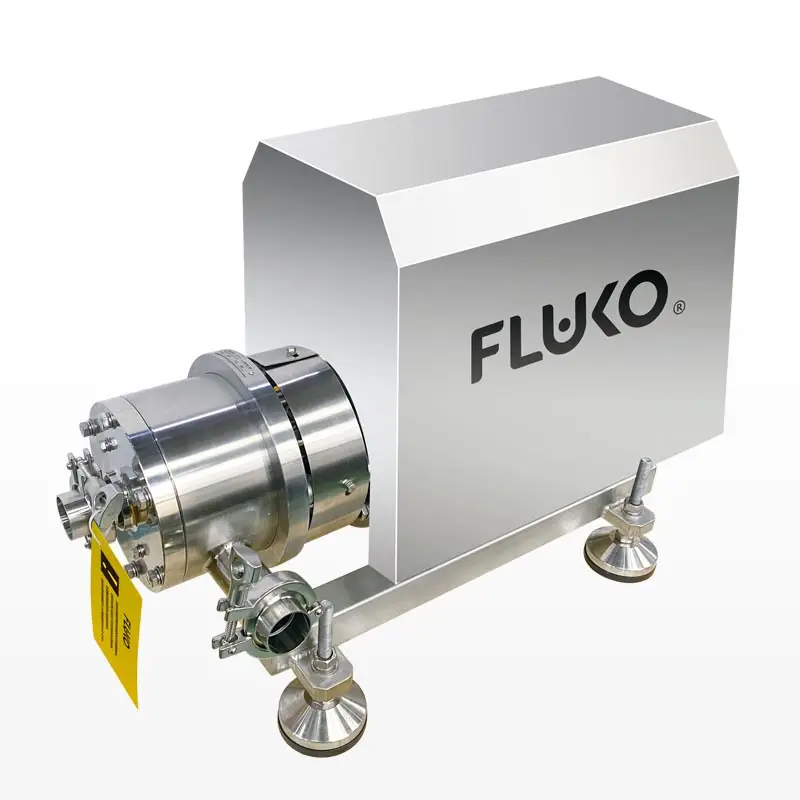
FLUKO’s FD1/SG series is designed for production-line integration, featuring a narrow-gap working head and a construction intended to meet sanitary requirements. The manufacturer states that the series complies with CIP/SIP cleanliness standards and supports dispersion, homogenization, crushing, blending, and mixing. These characteristics make the series worth evaluating for applications where both processing performance and cleaning access matter.
Establishing a Reliable Cleaning and Verification Procedure
Even well-designed equipment requires a documented cleaning process. Production teams should define cleaning steps for each product or product family, including the detergent used, circulation conditions, rinse requirements, and criteria for releasing equipment back into production. Procedures may differ between routine cleaning of the same product and changeovers involving different formulations.
Cleaning verification should use methods appropriate to the residue and risk. Visual inspection can identify obvious contamination, but it may not detect invisible chemical residues. Depending on the application, rinse sampling, surface swabbing, or other analytical methods may be needed to demonstrate that established acceptance criteria have been met.
A practical verification checklist includes:
Confirming that the cleaning cycle completed within approved parameters.
Checking accessible product-contact areas for visible residue.
Testing for relevant residues where required by the cleaning protocol.
Recording results, deviations, corrective actions, and approval for production restart.
Choosing Equipment for Long-Term Cleaning Efficiency
When comparing inline high shear mixers, manufacturers should evaluate cleaning performance alongside throughput, product quality, maintenance access, and compatibility with existing utilities. A system that reduces processing time but requires extensive manual cleaning may not deliver the expected overall productivity gains.
The FD1/SG series from FLUKO offers an option for manufacturers seeking production-grade inline homogenization with CIP/SIP compatibility. Before selection, buyers should request model-specific documentation and confirm the cleaning cycle, material compatibility, and validation requirements for their own formulations. Pilot testing or cleaning trials can help establish whether the proposed configuration meets site-specific acceptance criteria.
Make Cleaning Performance Part of Equipment Selection
Effective CIP depends on the interaction between equipment design, cleaning chemistry, operating conditions, and verification procedures. Understanding these factors helps production teams reduce contamination risks, improve changeover consistency, and manage cleaning-related downtime.
For facilities assessing an inline high shear mixers, the priority should be demonstrable cleanability rather than marketing claims alone. By reviewing technical documentation, validating cleaning procedures, and assessing the complete production line, manufacturers can determine whether FLUKO’s FD1/SG series or another suitable solution meets their operational and hygiene requirements. A well-planned approach makes cleaning performance an integral part of reliable manufacturing rather than an afterthought.
