

Comparing storage systems by energy capacity alone can hide the differences that determine whether a project works well after installation. Two systems with similar kilowatt-hour ratings may behave differently because of power capability, thermal control, safety design, switching performance, expansion options, software integration, or maintenance requirements.
Industrial scale battery storage therefore needs to be evaluated against the operating conditions of the site rather than against a single specification. A useful comparison starts with the facility’s intended battery duty and whether the complete system can perform it consistently.
Match Capacity and Power to the Operating Objective
Energy capacity answers how much electricity can be stored, while power rating determines how quickly that energy can be charged or delivered. Their relationship affects whether a battery is suited to short peak reduction, longer load shifting, backup operation, or a combination of duties.
Commercial and industrial energy storage should be sized from actual load behavior and the planned dispatch strategy, because the same energy capacity can produce very different results under different power and duration requirements.
The operating schedule matters as well. Frequent peak shaving creates a different duty profile from occasional backup, and demand response can introduce another set of dispatch conditions. Industrial scale battery storage must have enough usable capacity for the target service without forcing the system to operate outside its intended limits.
A project also needs a clear reserve policy if backup power is important, since energy used for routine savings is no longer available for an unexpected interruption until the battery is recharged.
Examine Safety and Thermal Control as a Complete Design
Battery risk is managed through multiple layers rather than one protective device. Cell behavior, electrical faults, temperature, fire protection, structural design, and system monitoring all influence how abnormal conditions are detected and contained.
Commercial and industrial energy storage is installed close to business operations in many projects, so safety design must be considered alongside site layout, maintenance access, and the expected operating environment. A strong architecture links protection from cell level to the complete system instead of relying on a single response after a fault has already developed.
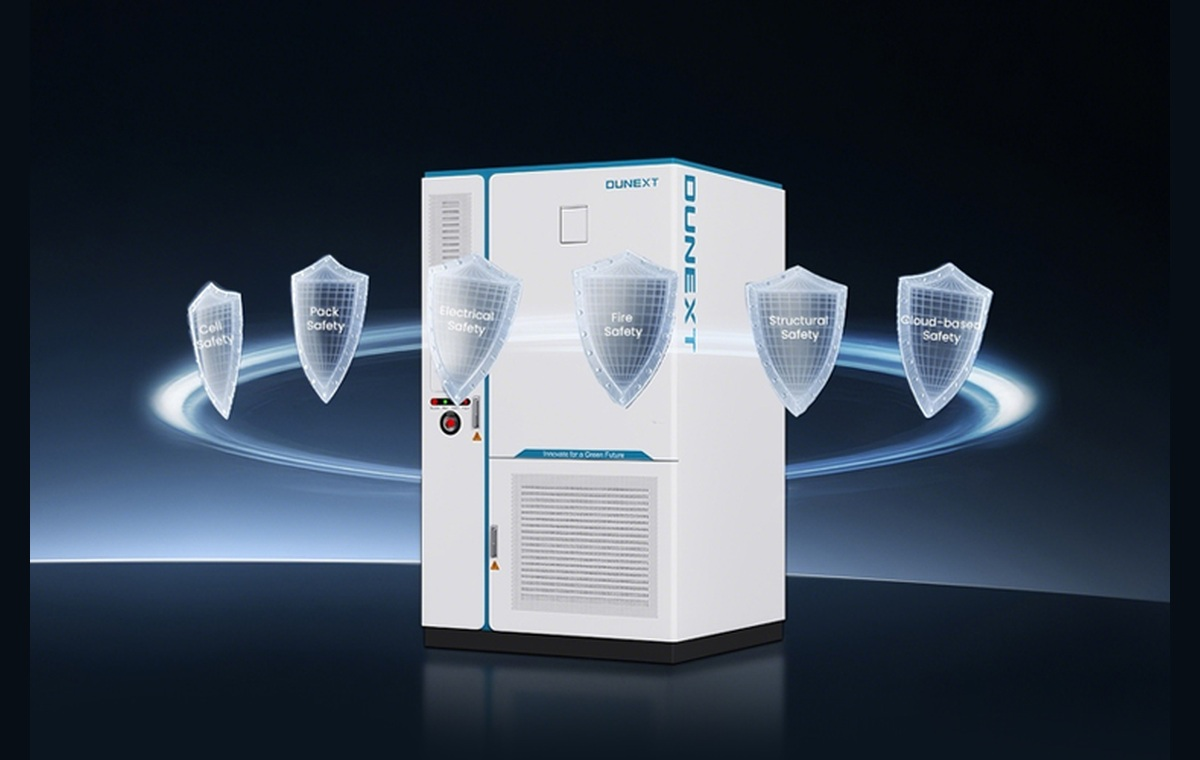
Against these criteria, Dunext organizes its C&I design around six layers of protection, together with cell-level management, manufacturing validation, and centralized energy control. That structure provides a concrete reference point for evaluating industrial scale battery storage: the useful question is not whether a supplier lists a safety function, but how protection is distributed across the battery and system.
Thermal consistency, monitoring, and operating limits also matter because uneven conditions can accelerate aging and make long-term performance less predictable.
Check How the Storage System Coordinates With the Site
A battery rarely operates alone. Industrial facilities may already have photovoltaic inverters, diesel generation, building loads, process equipment, and other third-party devices that need to be considered in dispatch decisions. Commercial and industrial energy storage becomes more useful when its control architecture can coordinate those resources instead of forcing operators to manage each subsystem separately.
Communication compatibility and clear operating priorities are therefore practical selection criteria, not optional software features.
Its EMS brings inverters, storage, diesel generation, and third-party equipment into one control system. Remote O&M, alerting, diagnostics, and centralized asset supervision are handled through DuLink. For industrial scale battery storage, those functions affect daily operation after commissioning: alarms need to reach the right people, asset status needs to remain visible, and dispatch rules need to reflect changing site conditions.
Digital management matters when it reduces fragmentation between equipment, operation, and maintenance.
Consider Continuity, Expansion, and Site Change
The storage system selected today may have to support a different facility several years later. Production expansion, new electrical loads, additional solar generation, or revised backup requirements can all change the amount of storage and power a site needs.
Available C&I configurations in Dunext’s portfolio range from about 20 kWh to 20 MWh, illustrating how commercial and industrial energy storage can be deployed across different site scales. Flexible capacity planning can reduce the risk that the initial configuration becomes a constraint when the facility changes.
Backup performance introduces a separate test of the chosen configuration. For supported configurations, on/off-grid transfer is listed at below 20 ms, including critical-load and MWh-level switching support. In an industrial scale battery storage project, fast transfer can be valuable where short interruptions disrupt sensitive processes, but switching speed must still be considered together with available backup energy and load priority.
A rapid transfer to an undersized reserve does not solve the underlying continuity problem, so power, duration, and critical-load definition have to be evaluated together.
Choosing a storage system is ultimately an exercise in matching architecture to duty. Capacity and power define what the battery can deliver; safety and thermal control influence how securely it can operate; EMS integration determines how effectively it coordinates with the site; and scalability affects whether the investment can remain useful as operating conditions evolve.
Dunext’s C&I portfolio provides examples of six-layer protection, centralized control, broad capacity coverage, remote management, and rapid switching, but each project still needs its own load and operating analysis. Over the life of the site, sizing, protection, control integration, and continuity requirements have to remain aligned with one another.
