

Modern organizations struggle to extract precise, context-aware answers from massive repositories of unstructured corporate documents. Traditional keyword-based search systems frequently return irrelevant files, forcing employees to spend valuable hours manually sorting through database entries. Implementing intelligent AI business solutions enables businesses to transition toward semantic search architectures that understand the underlying meaning of queries.
This cognitive approach forms the bedrock of Retrieval-Augmented Generation (RAG) systems, which combine semantic retrieval with advanced language generation. By converting corporate text files into dense mathematical vectors, systems can retrieve highly accurate background context for any user query. This systematic processing helps generated responses remain factual, relevant, and highly aligned with internal organizational knowledge.
Understanding the Mechanics of Vector Embeddings
Vector embeddings translate human language into high-dimensional numerical values that capture semantic relationships between different words or phrases. Traditional databases fail to recognize that “subscriber” and “customer” refer to similar concepts, but vector models identify this conceptual alignment instantly. This deep semantic understanding allows retrieval systems to find relevant context even when query terms do not match database files exactly.
To construct these precise mathematical representations, enterprises utilize a high-performance gemini AI embedding model to analyze their documents. This analytical framework maps complex sentence structures into unified vector spaces, preserving the subtle nuances of corporate data. The resulting high-fidelity vector representations drastically improve the overall precision of downstream search and generation applications.
Securing Data Sovereignty in Enterprise AI Hubs
Deploying artificial intelligence across sensitive corporate databases requires strict adherence to international data privacy and compliance standards. Many businesses hesitate to send proprietary intellectual property or financial records to external cloud networks due to security leaks. Establishing a self-contained, secure operational environment is crucial for protecting valuable corporate assets during AI processing.
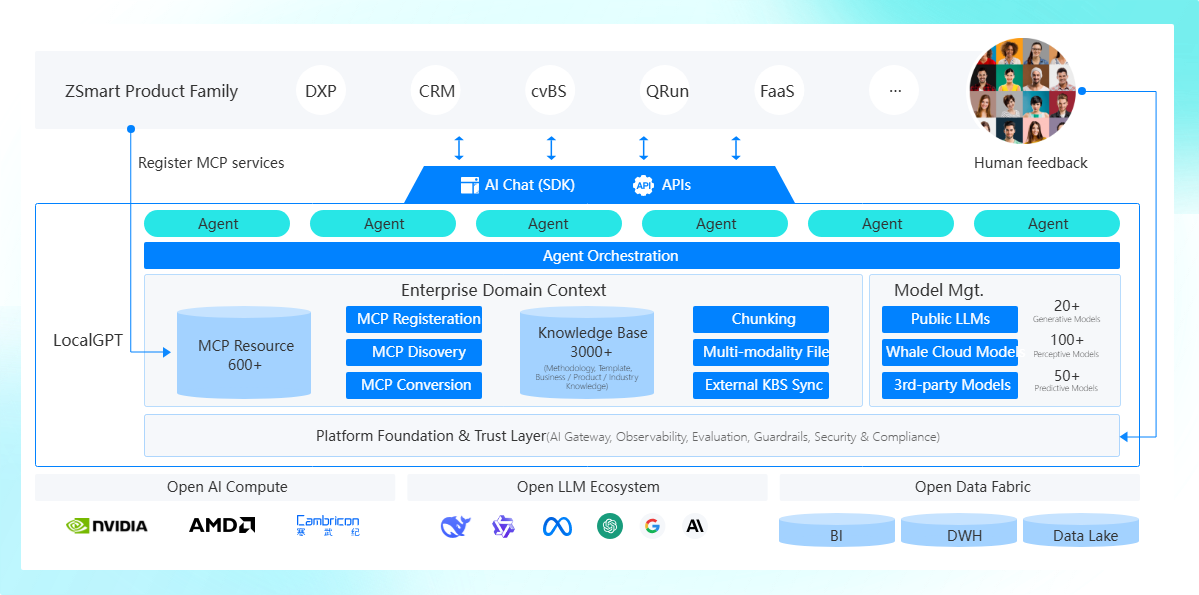
To address these sovereignty concerns, Whale Cloud provides LocalGPT, an enterprise-grade GenAI platform designed to maintain complete data control. This platform supports sensitive document processing and vector generation occur entirely within secure, designated cloud boundaries. By safeguarding critical information assets, organizations can confidently deploy modern language technologies without compromising intellectual property security.
Orchestrating Agents via Low-Code Environments
Transforming simple document retrieval into complex, automated business processes requires coordinating multiple intelligent software agents. These specialized agents must execute tasks sequentially, such as retrieving a billing document, checking a customer record, and drafting a personalized email. Creating these multi-step workflows can become incredibly labor-intensive without accessible development tools.
The utilization of low-code technology within the LocalGPT platform allows non-technical teams to design and manage agent workflows visually. This rapid orchestration capability helps businesses deploy specialized AI business solutions that automate repetitive analytical processes. Democratizing the creation of intelligent agents significantly reduces development bottlenecks and accelerates operational efficiency across departments.
Integrating Enterprise Data with Advanced GenAI
A common challenge in deploying corporate language models is the presence of fragmented data silos across active business units. Information stored in legacy databases, customer portals, and internal wikis must be unified to provide a reliable knowledge source. Establishing a dedicated data bridge is essential for feeding clean, real-time context into retrieval-augmented systems.
Through the Enterprise Data Connector (EDC) service, LocalGPT achieves deep integration between generative artificial intelligence and structured enterprise data. This connector continuously synchronizes enterprise data so that vector indexes generated by the embedding pipeline remain up to date. Keeping databases synchronized helps automated agents never retrieve outdated or incorrect factual references.
Connecting AI with Core Business Systems
Retrieval systems become far more valuable when they can perform physical operations rather than simply answering static text queries. For instance, an intelligent agent should be able to update a customer’s plan or schedule network maintenance after retrieving relevant records. Achieving this level of active automation requires secure, standardized communication pathways between AI engines and core software architectures.
By relying on Model Context Protocol (MCP) services, LocalGPT completes intelligent operations directly on existing enterprise systems. This protocol allows the gemini AI agent to connect seamlessly with diverse business architectures via standardized MCP interfaces, enabling real-time access to external tools and data sources. As a result, the platform moves beyond simple question-answering to execute complex business tasks autonomously and securely.
Enhancing Retrieval Quality with Multi-Model Compatibility
No single artificial intelligence model is optimal for every unique operational task or language requirement across global businesses. A company might require a highly specialized model for technical database indexing while utilizing a different system for customer-facing chat interfaces. Ensuring multi-model compatibility allows enterprises to select the most efficient engine for each specific step of their workflow.
The flexible infrastructure engineered by Whale Cloud supports diverse open-source and proprietary language models within a single, secure environment. This flexibility allows organizations to customize their retrieval-augmented setups by combining the best features of different models. This modular setup future-proofs previous software investments while paving the way for upcoming technological advancements.
Scalability and Adaptability in Modern Enterprises
As digital communication demands rise, companies must make sure their intelligent platforms can handle surging query volumes without performance degradation. Rigid architectures struggle to distribute processing workloads, which leads to slow response times and interrupted customer experiences. Implementing highly adaptable architectures helps processing power scales dynamically in response to real-time traffic.
Deploying comprehensive AI business solutions allows organizations remain highly agile in a fast-moving, data-driven global market. The scalable frameworks designed by Whale Cloud adjust automatically to maintain consistent, rapid response times under any load. This system resilience is fundamental to sustaining long-term commercial growth and maintaining outstanding operational standards.
Conclusion
Building robust, secure retrieval-augmented generation systems is essential for modern enterprises aiming to leverage their data assets safely. Utilizing a specialized gemini AI embedding model allows systems to grasp the semantic context of unstructured data with extreme precision. These mathematical models enable precise information retrieval, forming the ultimate foundation for intelligent corporate assistants.
Integrating flexible platforms like LocalGPT helps organizations can automate complex operations through low-code tools and secure database connectors. These modern upgrades protect data sovereignty while enabling seamless connection between language models and active business systems. Investing in standardized, secure AI business solutions remains the key to unlocking new productivity in the digital era.
